ABA Therapy Training Course
For current and future professionals in psychology, education and therapy.

Program Overview
- Next Cohort: 9 November 2026
- Format: 40 Hours | 100% Online
- Flexibility: 6 Months Extended Access to all replays
- Certification: Valid for local and international board certification.
Training Format
- Duration: 5 Weeks (Cohort schedule) or Self-Paced up to 6 Months
- Contact Hours: 40 Hours
- Format: 100% Online (Live Interactive & Streamable Replays)
- Instruction Language: Bahasa Indonesia
- Platform Access: 6 months full access to complete the course, materials, and replays.
- Certificate of Completion: Valid for IPAPI, IBAO, and LSK board certification.
ABA Companion is accredited by HIMPSI and leading organizations in the field of ABA.
Our course meets international standards for ABA training and is designed to support certification and high-quality clinical practice worldwide.
Weekly Schedule & Structure
Theory Modules
Live Interactive Workshop
Flexible Attendance Policy
Archived Live Classroom Recordings
Missed a live session due to clinic, work, or family commitments? Full, unedited recordings of every live class are uploaded directly to the student portal for on-demand streaming.
Full Completion
Credit
Watching the archived classroom recording fulfills your training requirements without penalty, allowing you to catch up with your cohort or progress independently.
Self-Paced Completion Within 6 Months
You are not locked into the 5-week schedule. Your enrollment includes 6 full months of extended access, giving you total freedom to start, pause, review, and complete the coursework whenever it suits your schedule.
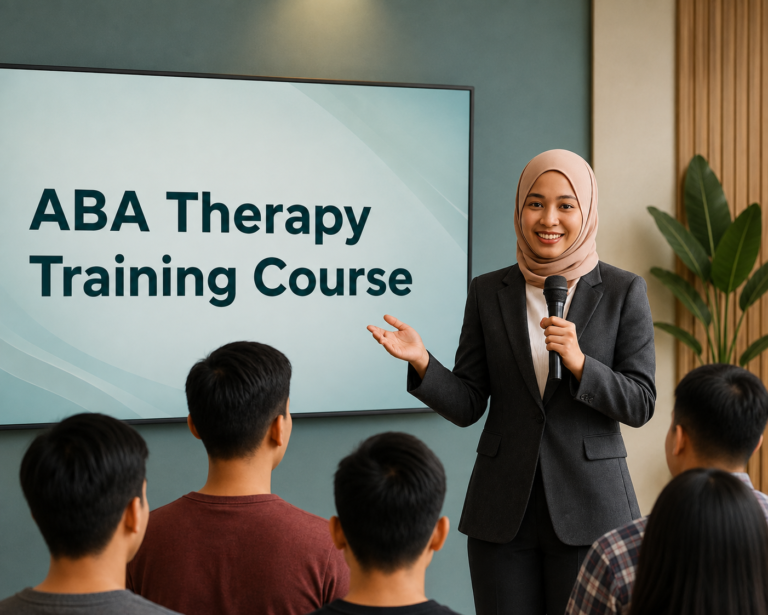
Why Join Our ABA Therapist Training Course?
- If you’re looking for an effective therapeutic model to support children with autism…
- If you want to evolve your practice into a more integrative and relational approach…
- If you’re seeking a comprehensive method that creates real, lasting change…
- If you want to feel confident and competent in your professional role…
Then this course is for you!
Our ABA Therapist Training Course takes you from theory to practice, providing you with a strong scientific foundation and practical tools to understand, support, and meaningfully connect with children with autism.
Why Choose Our ABA Training Course?
Practical & Scientific
Learn to apply ABA immediately through engaging lessons, real-life demonstrations, and hands-on exercises.
Exclusive Learning Materials
Access resources designed to support the practical application of ABA in your professional or family setting.
Expert Instructors
Taught by our lead case managers with extensive, real-world experience in autism therapy.
Live Interactive Lessons
Participate in live sessions to deepen your understanding, ask questions, and connect directly with instructors and peers.
International Certification Path
Our training supports your journey toward internationally recognized credentials in ABA.
Certificate of Completion
Receive a certificate you can use to apply for therapist roles in both private practices and organizations.
Luca Serventi, Psy, BCBA – Training Director

Our Approach to ABA Therapy
Integrative
To be truly effective, ABA must integrate and collaborate with other disciplines — developmental psychology, speech-language pathology, biomedical intervention and more. Therapy should be pluralistic, comprehensive, and responsive to the complexity of each child’s needs.
Relational
Autism is not a cognitive deficit — and therapy is not simply teaching discrete skills. True therapy begins with building the relationships that support learning, communication, and emotional growth. As therapists, our most important commitment is in supporting the relational development of our clients.
Responsive
At the heart of therapy is the therapist’s ability to adapt and respond, moment by moment, to the child and the context. This real-time attunement creates the conditions for meaningful, transformative experiences. It is within the ongoing, moment-to-moment relationship between child and therapist that true change takes place.
Developmental
Effective ABA must be informed by a deep understanding of both typical and autistic developmental trajectories. How do children naturally acquire language? Why do children with autism struggle to initiate or sustain social engagement? Our approach starts by answering these questions, so we can support real developmental progress.
Naturalistic
Over five decades of ABA applied to autism has shown that meaningful, lasting change happens in natural environments. Real interactions, natural antecedents, and social reinforcement are far more powerful than drills or token-based systems.
Evolving
Since the early 2000s, the field of ABA has been shifting toward more naturalistic, developmental, and integrative practices. As professionals, we have a responsibility to stay current and continually refine our approach to best support each child’s growth.

4,8 / 5
Who is this course for?
- Graduates in Psychology
- Graduates in Speech Therapy
- Experienced Therapists
- Graduates in Occupational Therapy
- Child Psychologists
- Pediatricians
What you'll learn?
- Rethinking Autism Diagnoses: Distinguish causal vs. descriptive diagnoses, analyze labeling risks, and explore current research on developmental etiology.
- Autism as a Transactional Process: Understand child development through dynamic child-environment interactions and relational brain dynamics.
- Behavior and Environment Fundamentals: Master core ABA concepts including the ABC model, stimulus control, and contextual motivators.
- Clinical Application of Autism Concepts: Practice observing, identifying, and separating real behaviors from subjective labels.
- Reinforcement and Behavior Change: Apply reinforcement principles, understand extinction concepts, and conduct preference assessments.
- Developing New Behaviors: Master prompting, fading, shaping, chaining, and generalization strategies across settings.
- Behavior Observation and Measurement: Learn objective measurement techniques, data collection methods, and visual graph interpretation.
- Behavior Change in Practice: Apply core behavioral procedures and use data-driven monitoring in clinical scenarios.
- Maximizing Engagement: Implement Joint Action Routines (JARs), Sensory Social Routines (SSRs), and clinical engagement metrics.
- Initiation and Turn Taking: Utilize transactional frameworks including Mirroring, Extending, and Matching to foster early language.
- Shared Control and Social Play: Expand developmental play skills using verbal markers, waiting strategies, and prompt fading.
- Social Engagement and Interaction: Apply responsive interaction techniques to strengthen child reciprocity and play-based learning.
- Speech and Language Acquisition: Implement effective modeling techniques during social interactions without over-correcting.
- Joint Attention and Tacting: Teach systematic initiating and responding routines to build joint attention, eye contact, and pointing.
- Manding and Communication: Structure the child's environment to create spontaneous functional requesting opportunities.
- Building Early Communication Skills: Integrate social-interaction principles to support language milestones and meaningful functional expression.
- Supporting Child Wellbeing: Optimize overall development by structuring daily routines, sleep, nutrition, and physical activity.
- Addressing Challenging Behaviors: Identify behavior functions using ABC frameworks and introduce functional alternative behaviors.
- Fostering Independence and Autonomy: Apply the Zone of Proximal Development to reduce over-prompting during daily routines.
- Ethics in Professional Practice: Maintain professional boundaries, client confidentiality, and ethical decision-making in clinical settings.
Contact Sales
Are you part of a centre, school or a hospital and wants to train your staff?
Please leave us your contact details so we can deliver a customized offer tailored to your company’s need. No commitment.
- Special price for more than 4 participants
- Tailored content to your area of interest and organizational needs
- Opportunity for hands-on coaching and curriculum development
Please note: This form is only for organizations (e.g. schools, clinics, hospitals) interested in group training for their staff.
If you are an individual looking to join the course, please click here to register.